


For rooftop deck projects, this doesn’t mean you can’t build. It means you need to account for LPC review in your planning timeline and understand what triggers their involvement. In our experience, landmark district status is a moderate factor that’s entirely manageable if you plan for it early. It becomes a problem only when homeowners don’t realize they’re in a landmark district until the project is already designed, and then discover that certain elements need to be revised or that the timeline just got longer.
This guide covers how LPC review applies to rooftop projects, which neighborhoods it affects, what triggers review, the permit types involved, and how to plan around it.
What the Landmarks Preservation Commission reviews
LPC’s regulatory authority covers the exterior of designated landmark buildings and buildings within historic districts. The key word is exterior, and for rooftop projects, the practical question is whether the proposed work is visible from the street or a public place.
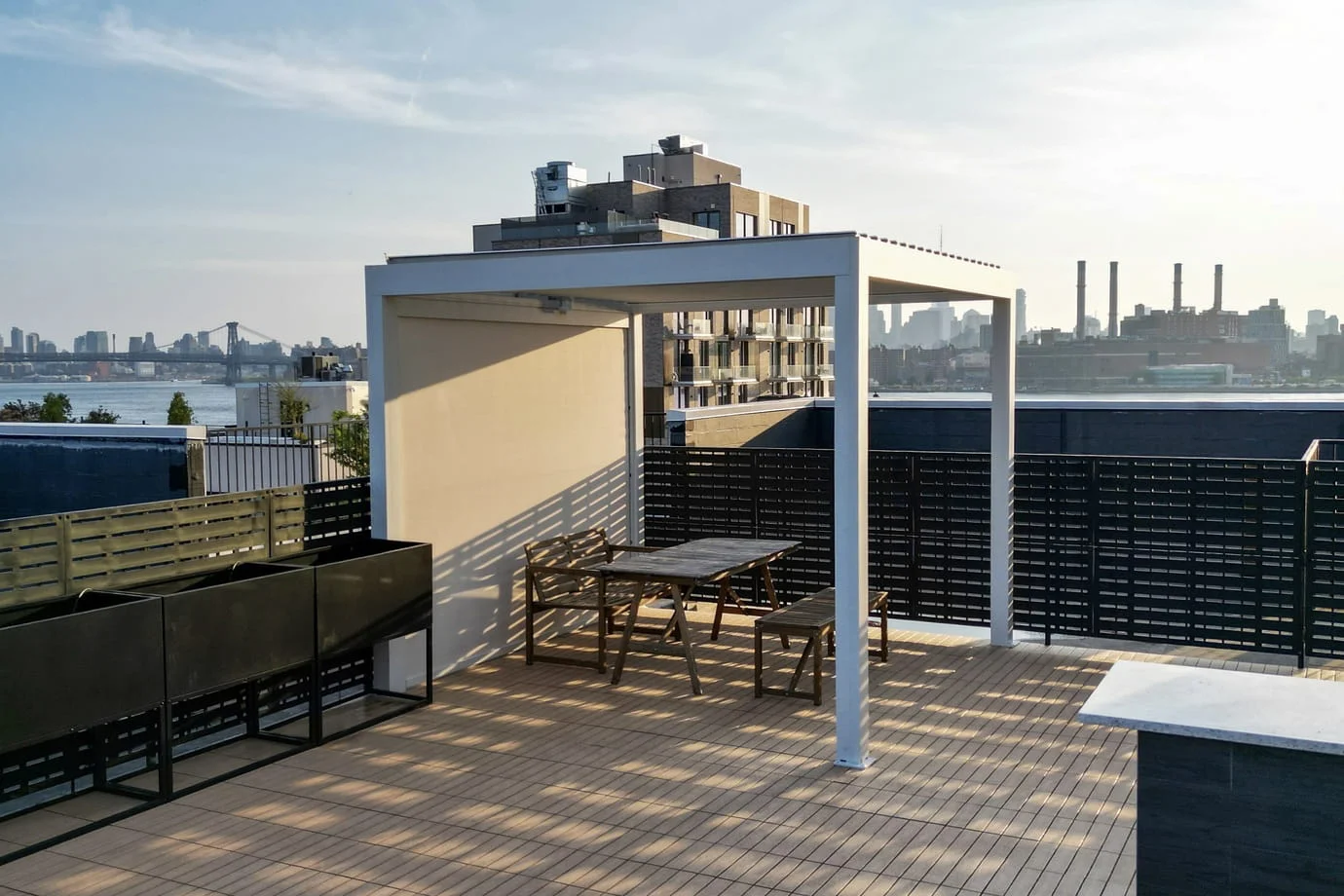
Rooftop work that isn’t visible from the street generally does not trigger significant LPC scrutiny. A paver terrace, low planters, and furniture on a rooftop that’s shielded from public view by the building’s parapet typically won’t raise LPC concerns. But taller structures that rise above the roofline and become visible from the street (pergolas, privacy screens, railings, and mechanical equipment enclosures) are where LPC review comes into play.
The visibility question isn’t always obvious. A pergola that seems tucked behind a tall parapet wall might still be visible from a specific angle on the street, from an adjacent park, or from a neighboring building’s public space. Your architect or expeditor will assess visibility as part of the LPC application process, but it’s worth thinking about early: if your planned rooftop features will be visible above the roofline, LPC will have an opinion on what they look like.
Which rooftop elements trigger LPC review
The rooftop features that most commonly trigger LPC involvement on our projects are pergolas, privacy screens, and railings, essentially anything tall enough to be visible from the street.
Pergolas are the most significant trigger because of their height and visual profile. A pergola rising 8 to 10 feet above the roof surface will almost certainly be visible from street level on most buildings in historic districts. LPC will review the design, materials, and color to ensure the structure is appropriate to the building’s character and doesn’t detract from the streetscape. This doesn’t mean pergolas are prohibited. It means the design needs to work within LPC’s aesthetic framework for that particular district.
Privacy screens and wind walls that rise above the parapet line are another common trigger. LPC may have preferences about materials, transparency levels, and color. A modern black aluminum screen might be perfectly appropriate in one district and require modification in another.
Railings and guardrails that are visible above the roofline can also trigger review, particularly if they use materials or styles that contrast sharply with the building’s historic character.
Surface-level features like paver decks, low planters, built-in seating, and lighting at the deck level generally don’t trigger LPC review because they aren’t visible from the street. This is one reason why a well-designed paver terrace with thoughtful furniture and lighting can be a particularly good fit for landmark district buildings: you get a fully functional outdoor living space without adding visible structures above the roofline.
LPC permit types
LPC issues three types of permits, and the type depends on how the proposed work affects the building’s protected features. Your architect or expeditor determines which applies and handles the application through LPC’s online portal, Portico.
Certificate of No Effect (CNE) is issued when the proposed work requires a DOB permit but doesn’t affect the building’s protected architectural features. For rooftop projects, this might apply when the work is entirely below the parapet line and has no visible exterior impact. A CNE is the fastest LPC approval path.
Permit for Minor Work (PMW) is issued when the work affects significant protected features but doesn’t require a DOB permit. This is less common for rooftop deck projects, which typically do involve DOB filings.
Certificate of Appropriateness (CofA) is required when the work affects significant protected features and doesn’t qualify for a staff-level approval. For rooftop projects, this applies when visible structures like pergolas or rooftop additions are proposed. A CofA can be issued at the staff level (the majority of cases, with about 95% of all LPC permits issued by staff) or may require a public hearing before the full Commission.
The practical distinction that matters most: staff-level approvals are faster and don’t require a public hearing. Many applicants work with LPC staff to modify their designs to qualify for staff-level approval rather than going through a full Commission hearing. Your architect can often adjust materials, colors, or dimensions during the review process to land within staff-level guidelines.
How the LPC review affects your timeline
LPC review adds time to the front end of your project, and the amount depends on the type of permit required.
For minor work or a Certificate of No Effect, where the proposed changes don’t significantly affect the building’s protected features, approval can typically be obtained within a month. These are the more straightforward applications where the scope is limited, and the design falls within staff-level guidelines.
For a Certificate of Appropriateness, which applies to visible structures like pergolas, rooftop additions, and privacy screens, the timeline is longer. Expect 3 to 6 months for a CofA, particularly if the application requires revisions or goes to a public hearing before the full Commission. Even staff-level CofA approvals take longer than a CNE because the review involves a more detailed assessment of how the proposed work relates to the building and the district.
The important thing is that the LPC review happens before the DOB filing. You cannot file for a DOB permit on a landmarked property without LPC sign-off first. This means the LPC timeline gets added to the front of the project schedule, not run in parallel with DOB permitting. If you’re planning a spring build, that LPC review needs to start months in advance, not in March when you’re hoping to start construction.
This sequencing is the most common source of timeline surprises for homeowners in landmark districts. People plan backward from their desired completion date, account for construction time and DOB permitting, and then discover that LPC review adds weeks or months before the DOB process even begins.
Materials and design in landmark districts
LPC regulates materials and colors for work on landmarked buildings. The specific requirements vary by district and building type. What’s appropriate for a pre-war co-op on the Upper West Side may differ from what LPC expects on a Federal-style townhouse in Cobble Hill.
In general, LPC favors materials and colors that are compatible with the building’s historic character and don’t create a jarring visual contrast with the surrounding streetscape. For rooftop structures, this often means muted or traditional color palettes rather than bright or high-contrast finishes, materials that are consistent with what’s already present on the building and neighboring rooftops, and designs that minimize visual bulk and maintain a relatively low profile above the roofline.
This doesn’t mean every rooftop in a landmark district has to look the same. LPC evaluates each application individually based on the specific building and context. Modern materials like aluminum and composite are regularly approved. The question is whether the design, color, and scale are appropriate to the setting, not whether the materials are historically accurate.
Which neighborhoods does this affect?
LPC’s jurisdiction covers more than 37,000 properties across 150+ historic districts in all five boroughs. For our client base, the landmark districts that come up most frequently are the West Village and Greenwich Village (one of the city’s largest historic districts, covering a significant portion of the neighborhood), the Upper West Side (multiple overlapping historic districts covering much of the residential core), and Cobble Hill in Brooklyn (a smaller but densely designated district with strict preservation standards).
Other NYC landmark districts that are relevant to rooftop projects include the Upper East Side, Brooklyn Heights, Park Slope, Fort Greene, and Clinton Hill. If you’re not sure whether your building is in a landmark district, you can check on the NYC Landmarks Preservation Commission website or call 311.
How to plan for LPC on a rooftop project
The process for a rooftop project in a landmark district follows this sequence: design the project with LPC requirements in mind, submit the LPC application through your architect or expeditor, receive LPC approval, and then file with DOB for construction permits.
We coordinate with the client’s architect or expeditor on LPC matters. Our role is to provide construction expertise on what’s buildable and recommend materials and designs we know work well, while the architect handles the LPC application, design documentation, and communication with LPC staff.
A few practical tips based on our experience working in landmark districts:
Know your district status before you start designing. Discovering you’re in a landmark district after you’ve already committed to a specific pergola design, material, and color can mean going back to the drawing board. Check first, design accordingly.
Design for staff-level approval. The vast majority of LPC permits are issued at the staff level without a public hearing. Your architect can design with staff-level guidelines in mind, which keeps the timeline shorter and the process more predictable. If the initial submission doesn’t qualify, LPC staff will often suggest modifications that would.
Account for the timeline upfront. Minor LPC approvals can take about a month, while a Certificate of Appropriateness can take 3 to 6 months. Build this into the front end of your project timeline. If you’re planning a project for spring or summer, start the LPC process well in advance so that DOB permitting can begin as soon as LPC approval is in hand.
Consider visibility in your design. If you can keep structures below the parapet line, you may reduce or eliminate LPC’s scope of review entirely. A well-designed terrace with pavers, low built-in seating, ambient lighting, and strategically placed planters can deliver a beautiful outdoor space without adding visible structures above the roofline.
How does this fit with other regulatory requirements
LPC review is one piece of a larger regulatory picture for NYC rooftop projects. It works alongside, not instead of, the DOB permit process, NYC zoning rules for rooftop structures, and any building-specific requirements like co-op or condo board approval.
The good news is that these processes, while layered, are well-established. An architect experienced with NYC landmark districts knows how to navigate all of them in sequence, and a contractor experienced with rooftop projects in these neighborhoods knows how to design and build within the constraints. With the right team and enough lead time, a landmark district rooftop project follows a clear, manageable path from design to completion.
Considering a rooftop project in a landmark district?
We build rooftop decks across Manhattan and Brooklyn, including in landmark districts. If your building is in a historic district and you’re wondering what’s possible on your roof, we can help you understand the options during an initial consultation and connect you with architects who specialize in LPC applications.



-2.svg)