

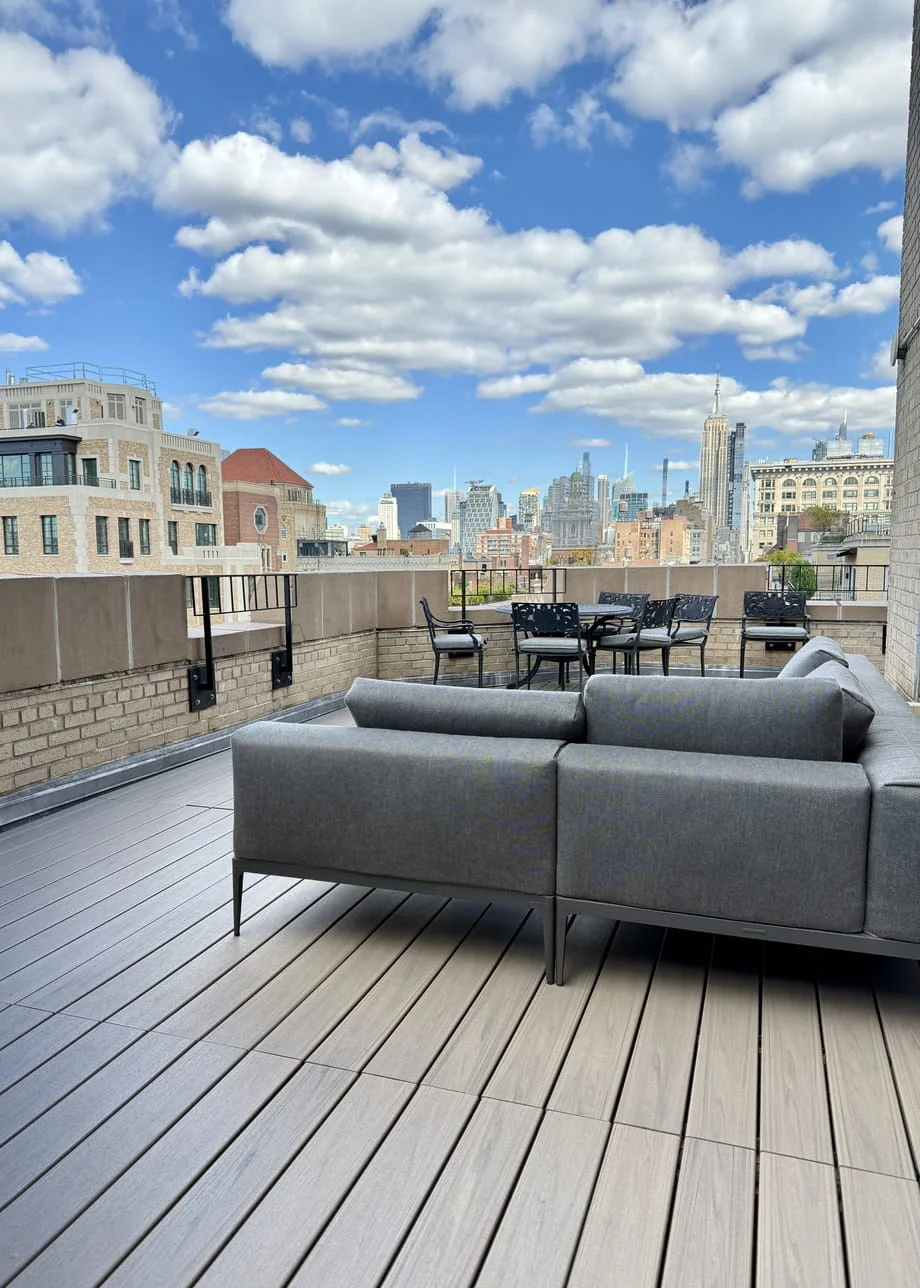
Whether you’re a penthouse owner with private roof access, a building board considering a shared terrace, or a developer building out rooftop amenities, it helps to understand the logistical realities that make Manhattan high-rise projects different from a Brooklyn brownstone or Queens townhouse rooftop.
This guide covers the specific considerations we walk clients through on every Manhattan rooftop project, from getting materials to the roof to navigating building management requirements.
Getting materials to the roof
On a Brooklyn brownstone or a three-story townhouse, material delivery is relatively straightforward. Materials get dropped off at the curb, carried through the building or up an exterior staircase, and staged on the roof. On a Manhattan high-rise, the path from the truck to the rooftop is significantly more complex.
There are two primary delivery methods, and most Manhattan projects use both.
Freight elevator. This is the default path for most rooftop deck materials, including pavers, pedestals, decking boards, railing components, and smaller items. The constraint is that everything has to fit inside the elevator and be moved through service corridors and up stairwells to the roof. That means materials need to be broken down into manageable loads, and deliveries take longer because the elevator is shared with other building operations. Most buildings assign specific time windows for freight elevator access, so material deliveries have to be scheduled well in advance and coordinated with building management.
Crane. For larger or heavier items that won’t fit through the freight elevator, such as full pergola frames, oversize structural steel, large planters, or bulk material loads, a crane lift is required. Crane operations in Manhattan involve a DOT street permit for the temporary lane or sidewalk closure, coordination with the building to ensure the roof is clear and rigging points are accessible, and scheduling around the building’s own restrictions. It adds cost and planning time, but for certain items, there’s simply no other way to get them to the roof.
The practical takeaway is that material logistics need to be planned as part of the project scope, not figured out after the contract is signed. We include a delivery and staging plan in every Manhattan proposal that accounts for elevator scheduling, crane lifts (if needed), and the number of delivery days required.
Work hour restrictions
Manhattan buildings impose stricter work hour rules than most outer-borough projects. The typical allowed window is 8:00 AM to 4:00 PM, with quiet work only before 9:00 AM. That means no power saws, hammering, or other noise-generating activities during that first hour. Crews can stage materials, set up equipment, and do layout work, but the loud construction doesn’t start until 9:00.
Federal holidays are almost universally restricted, meaning no work at all. Some buildings also restrict work on weekends, limit the number of workers allowed on-site at any given time, or require that all tools and materials be removed from common areas at the end of each workday.
These restrictions compress the productive work window compared to a project in Brooklyn where you might have a full 8:00 AM to 5:00 PM day with fewer building-imposed limitations. The result is that a Manhattan rooftop project can take more calendar days to complete than the same project would in another borough, not because the work itself is more complex, but because there are fewer productive hours per day.
This is worth understanding for scheduling expectations. When we quote a timeline for a Manhattan project, it accounts for building-specific work hour rules. A project that would take two weeks with a full workday might take three weeks under restricted hours.
Insurance and building requirements
Exterior work on a Manhattan high-rise requires higher insurance coverage than a typical residential project. Buildings and their management companies generally require higher general liability limits, additional endorsements naming the building, its management company, and sometimes the co-op or condo board as additional insured parties.
These aren’t optional. If a contractor’s insurance doesn’t meet the building’s requirements, they won’t be allowed to start work. This is something to verify early in the process. We carry the appropriate coverage levels for Manhattan high-rise work and are familiar with the documentation that building management offices require. If a contractor you’re evaluating is hesitant about providing a certificate of insurance or isn’t familiar with the process, that’s a signal they may not have experience working in managed buildings.
Beyond insurance, most Manhattan buildings require a package of documents before any work can begin. This typically includes proof of insurance, a work schedule and scope description, a list of workers who will be on-site, and sometimes a deposit or fee to the building for wear and tear on common areas. The managing agent or super usually coordinates this process, and it can take one to three weeks to get everything approved and scheduled, so it needs to happen well before the planned start date.
Board approvals
If you’re in a co-op or condo building (which covers most Manhattan residential buildings with rooftop access) your project will likely need board approval before construction can begin. This is true whether the rooftop is deeded to your unit, designated as a limited common element, or accessed through some other arrangement in your proprietary lease or offering plan.
We’ve written a separate guide on the co-op and condo board approval process that covers this in detail, but the short version is: expect to submit architectural plans, material specifications, a construction timeline, proof of insurance, and possibly an alteration agreement. The board review process can take anywhere from a few weeks to several months depending on the building.
The key point for any Manhattan rooftop project is to start the board approval process early, ideally before finalizing the design. If the board has specific material restrictions (some buildings prohibit combustible materials on rooftops), structural load limits, or aesthetic requirements, you want to know about those constraints before the entire project is designed around assumptions that won’t be approved.
Co-op boards tend to have more discretionary authority than condo boards, which means the approval process can be less predictable. Starting early gives you a buffer for revisions, questions, and the general pace of board decision-making.
Permits and code compliance
Manhattan rooftop decks are subject to the same NYC Department of Buildings requirements as any other borough. You’ll likely need a DOB permit depending on the scope of the work. Our guide to NYC roof deck permits covers when a permit is required and what the process looks like.
The one Manhattan-specific nuance worth noting is that buildings in historic or landmark districts face an additional layer of review from the Landmarks Preservation Commission. If your building is in a designated historic district (which includes large portions of the Upper West Side, Upper East Side, Greenwich Village, and other Manhattan neighborhoods) any visible exterior modification may need LPC approval in addition to DOB permits. Rooftop structures that are visible from the street, including pergolas, railings, and privacy screens, are the most common triggers for LPC review.
Your architect or expeditor can determine whether your building falls within a landmark district and whether the proposed work requires LPC review. This is another reason to start the planning process early for Manhattan projects, since adding an LPC review to the timeline can add weeks or months to the approval process.
Does a Manhattan rooftop deck cost more?
The honest answer is: it depends on the building, not the borough.
The materials and construction labor for a Manhattan rooftop project are essentially the same as a Brooklyn or Queens project of the same size and scope. What can differ is the logistical cost, including crane lifts, extended timelines due to work hour restrictions, and the overhead associated with building management coordination.
A penthouse project in a building with a straightforward freight elevator setup, reasonable work hours, and a responsive management office might cost very close to the same project in Brooklyn. A project in a building with severe access limitations, a months-long board process, and crane requirements for every material delivery will cost more, and the premium is driven by logistics, not by geography.
When evaluating proposals for a Manhattan rooftop project, look for how logistics have been accounted for. Our proposals break out delivery and access costs so you can see what’s driving the number, rather than just adding a blanket “Manhattan premium” to the total.
Who we work with on Manhattan rooftop projects
Most of our Manhattan rooftop projects fall into three categories. Penthouse owners with exclusive or semi-exclusive roof access make up a large portion of our work. These are homeowners who want to transform underused roof space into a private terrace, often as an extension of their living space for entertaining, dining, or simply having an outdoor retreat in the city.
We also work on shared rooftop spaces for co-op and condo buildings, where the board is looking to create or upgrade a common terrace for all residents. These projects involve a different approval dynamic since the board is both the client and the approving body, but the construction process is the same.
And we work with developers on new construction and gut renovation projects, building out rooftop amenity spaces as part of the overall building package. Developer projects often move on a tighter timeline tied to the building’s certificate of occupancy or sales schedule.
The scope across all three ranges from relatively simple (porcelain pavers, a few planters, and lighting) to comprehensive rooftop builds with pergolas, outdoor kitchens, fire features, and full privacy screening. The design and material options are the same as any NYC rooftop project; the difference is in how the project gets planned and executed within the constraints of a managed high-rise building.
Our work spans the Upper West Side, Upper East Side, and downtown neighborhoods including Chelsea, the West Village, and Tribeca. Each area has its own building stock characteristics. Pre-war co-ops on the Upper East Side operate differently from new-construction condos in Chelsea, but the core principles of planning, logistics, and building coordination apply across all of them.
Planning a Manhattan rooftop deck
Whether you’re a penthouse owner, a building board exploring a shared terrace, or a developer building out rooftop amenities, the best first step is to understand the building’s specific requirements before investing time in detailed design. Find out what the board requires for approval, what the building’s work hour restrictions are, and whether there are any material restrictions or structural limits on the roof.
Once you know the rules, everything else (design, materials, layout, features) follows the same process as any rooftop deck project in NYC. The materials are the same, the construction methods are the same, and the finished result is the same. The path to getting there just takes a bit more planning in Manhattan.



-2.svg)