

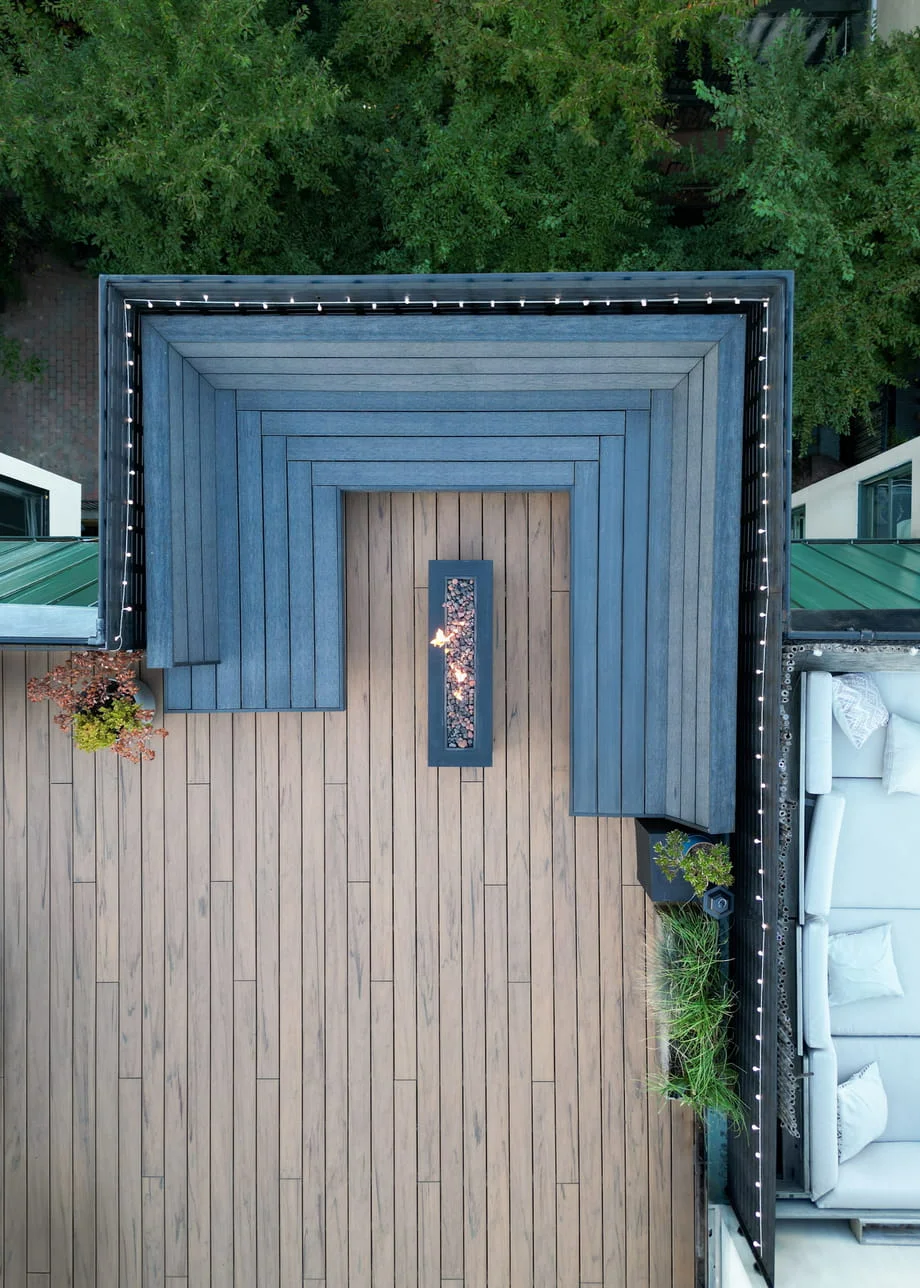
We’re certified installers of both brands and have been building with Trex and TimberTech across Manhattan, Brooklyn, Queens, and Staten Island for years. The honest answer to “which is better?” is that it depends on the project. A backyard patio in Bay Ridge calls for a different product than a rooftop deck on the Upper West Side, and the reasons go well beyond personal taste. (You can see a TimberTech patio we built in Bay Ridge as one example of how the right product choice shapes the finished result.)
This guide breaks down the product lines, pricing, fire ratings, and performance differences that actually matter when you’re building in NYC, so you can make a decision based on your specific project, not marketing claims.
Understanding the product tiers
Both Trex and TimberTech offer tiered product lines that range from budget-friendly composites to premium PVC boards. The naming can get confusing, so here’s how they map to each other.
Entry-level composite covers the Trex Enhance and TimberTech PRO lines. These are capped composite boards, a wood-plastic composite core wrapped in a protective polymer shell. They’re durable, low-maintenance, and offer a good selection of colors. For backyard patios, ground-level decks, and projects where value matters, these are excellent options.
Premium composite is where Trex Transcend Lineage sits. Lineage uses Trex’s SunComfortable technology to keep the surface cooler in direct sunlight, a meaningful benefit on south-facing patios and terraces that bake in summer. It features realistic multi-tonal color blending and comes in wider board options for a more modern look. Note that Lineage is a composite, not PVC, so it does not carry a Class A fire rating and is not suitable for rooftop applications that require fire-rated materials.
Advanced PVC / capped polymer is TimberTech’s AZEK line, which includes the Vintage and Landmark collections. These aren’t composite at all. They’re cellular PVC with no wood fibers in the core, which means zero moisture absorption. That makes them exceptionally resistant to mold, mildew, and the freeze-thaw cycles that NYC weather delivers every winter. The Vintage collection is their designer tier with the most realistic hardwood visuals, while Landmark offers a crosscut cathedral grain that mimics white oak and walnut.
The tier-to-tier mapping matters when comparing prices and performance. Trex Enhance competes directly with TimberTech PRO, both are capped composites at a similar price point. At the premium PVC level, TimberTech AZEK Vintage and Landmark now compete with the new Trex Refuge. Trex Lineage sits in between as a premium composite without a direct TimberTech equivalent, since TimberTech’s step up from PRO goes straight to PVC. Understanding which tier you’re comparing prevents the apples-to-oranges confusion that plagues most online reviews.
What they cost in NYC
Material costs between these brands follow a predictable pattern: at comparable tiers, TimberTech runs slightly higher than Trex. The gap is modest at the entry level and widens as you move into premium lines.
For a typical 400 square foot deck, a common size for Brooklyn backyards and Manhattan rooftops, expect the material cost alone to range roughly from the low thousands for entry-level boards to double that for premium PVC. The difference comes down to which product line you choose: an entry-level composite like Trex Enhance or TimberTech PRO costs significantly less per square foot than a premium PVC board from the AZEK Vintage or Landmark collections.
What matters more than materials is the total installed cost. On a 400 square foot NYC deck, material typically represents about 20 to 30% of the project total. The rest goes to structural framing, labor, permits, and for rooftop projects, crane access, staging, and building coordination. Whether you’re comparing Trex Enhance to TimberTech PRO or TimberTech AZEK Vintage to Trex Refuge, the labor and logistics cost remains essentially the same across brands at the same tier. So while premium boards do cost more, the percentage increase to the overall project is smaller than you might expect.
As a rough guide, entry-level composite decks in NYC typically fall in the $15,000 to $25,000 range for 400 square feet fully installed, while premium PVC projects run $25,000 to $35,000 or more depending on access complexity and structural requirements. These ranges assume standard railing and no built-in features like benches or planters.
If you’re weighing composite against natural hardwood like ipe, we’ve written a detailed cost comparison that breaks down the 25-year total cost of ownership.
Fire ratings: the NYC rooftop factor
This is where the comparison gets critical for anyone building on a rooftop in New York City. NYC has strict rules about combustible materials on rooftops, and not every decking product qualifies. Knowing which specific product lines meet the requirements narrows your options quickly.
Currently, only two product lines from these brands carry both a Class A flame spread rating and ignition-resistant designation. The TimberTech Advanced PVC Vintage and Landmark collections, and the new Trex Refuge PVC line, which launched in early 2026.
TimberTech’s AZEK Vintage and Landmark collections have held their Class A rating and WUI (Wildland-Urban Interface) compliance for years. The board's self-extinguishes when the flame source is removed, and the PVC core contains no organic material that would fuel a fire. For NYC rooftop projects where fire compliance is required, these collections have been the go-to option.
Trex Refuge is the newer entrant. Also, a cellular PVC product (not composite), it meets ASTM E84 Class A flame spread requirements and IWUIC ignition-resistance standards. It’s currently available in two colors — Martis Valley, a warm beige, and Point Reyes, a coastal grey — and is backed by a 50-year limited residential warranty. It can be sourced in the NYC market, though availability is still more limited than established lines, so plan for potential lead time.
Standard composite lines from either brand, Trex Enhance, Trex Lineage, TimberTech PRO, do not meet Class A requirements. If your project is on a rooftop, your options are limited to the PVC lines above. For a full breakdown of what NYC code allows on rooftops, see our guide to combustible materials and rooftop decking code.
This is one of the most important distinctions in the entire Trex vs. TimberTech comparison, and one that most online reviews completely ignore. If you’re building a rooftop deck in Manhattan or any NYC building with fire code requirements, the conversation starts with which fire-rated PVC line works best for your project, not which composite board looks nicest.
Performance and durability
Both Trex and TimberTech make exceptionally durable products that resist fading, staining, scratching, and moisture. After installing both brands on NYC rooftops, patios, and terraces across all five boroughs, we can honestly say they perform well in New York’s demanding climate, with hot summers, freezing winters, and everything in between.
There are, however, a few material-level differences worth noting.
Moisture resistance is where PVC has a structural advantage over composite. TimberTech AZEK boards absorb virtually zero moisture because there’s no wood fiber in the core. Composite boards (from either brand) contain some wood content and can absorb small amounts of moisture over time, though the capping layer prevents most issues. On rooftops where standing water is common after rainstorms, PVC has an edge.
Heat retention matters on any sun-exposed deck. Trex Lineage includes SunComfortable technology, which Trex says keeps the surface cooler than standard composite in direct sunlight, a real benefit on south-facing patios. TimberTech AZEK also claims to stay up to 30 degrees cooler than many competitive composites. Both perform better than dark-colored wood in full sun.
Scratch and dent resistance is comparable across premium lines from both brands. TimberTech AZEK uses its proprietary Alloy Armour Technology for surface protection, while Trex Lineage uses a high-performance shell. In practice, we haven’t seen a meaningful difference in how they hold up on residential projects.
Color selection and design
Both brands offer a wide color range, but the aesthetics are slightly different. Trex leans toward warm, natural tones with subtle grain patterns, while TimberTech AZEK, particularly the Landmark collection, offers bolder, more dramatic color variation with cascading highlights and lowlights that mimic the look of premium hardwoods like white oak.
Two colors we see NYC homeowners choose again and again: TimberTech Landmark French White Oak for its cool, contemporary tone that pairs beautifully with grey and white facades, and Trex Transcend Lineage Carmel for a warm, rich brown that complements brick and brownstone exteriors.
That brings up a design principle we follow on every project: match the deck color to the exterior of the building. Brownstone and brick facades pair naturally with warm brown tones from either brand. White, grey, or light-colored stucco and siding look best with cool grey or weathered wood tones. This sounds simple, but it’s the single most effective way to make a deck feel like it belongs on the building rather than looking like an afterthought. Your contractor should be able to bring board samples to the site and hold them against the facade before you commit to a color.
Warranty comparison
Both brands back their premium products with strong warranties, though the structure differs.
Trex offers a 25-year limited residential warranty on Enhance and a 50-year limited residential warranty on Transcend Lineage and Refuge. Their fade and stain warranty runs 25 years on Enhance and 50 years on premium lines.
TimberTech AZEK Vintage and Landmark carry a limited lifetime product warranty with a 50-year limited fade and stain warranty, the strongest coverage in the composite/PVC decking industry.
In practice, warranty claims on either brand are rare. Both products are well-engineered, and failures are uncommon. The real question isn’t whether the warranty is 25 or 50 years, it’s whether the product will still look good in 15 years without maintenance. On that front, both deliver.
How to choose: a decision framework
After installing both brands on hundreds of NYC projects, here’s how we guide clients through the decision.
Choose Trex Enhance if your project is a backyard patio, ground-level terrace, or any application where fire rating isn’t required and budget matters. It’s a proven, reliable product that looks great and holds up well in NYC weather. It’s also the most widely available composite on the market, which means shorter lead times.
Choose Trex Transcend Lineage if you want a premium composite with heat-mitigating technology for a ground-level deck or patio, especially one that faces south or west and gets heavy afternoon sun. The SunComfortable surface makes a noticeable difference on barefoot summer days. Lineage is also available in a new 1"×4" profile for multi-width designs and custom detailing. Keep in mind that Lineage is not fire-rated, so it’s not an option for rooftop decks that require Class A compliance.
Choose TimberTech AZEK Vintage or Landmark if you’re building a rooftop deck that needs to meet NYC fire code, or if you want the absolute best moisture resistance for a rooftop or elevated application where standing water is a concern. The fire-rated PVC construction solves a compliance problem that composite boards simply can’t. If you want the most realistic hardwood look, Vintage is the top of the line. If you prefer a crosscut grain with a more contemporary feel, Landmark is excellent.
Choose Trex Refuge if you want a fire-rated PVC option from Trex. It’s new to market with a more limited color selection than AZEK, but it gives you Class A fire performance with Trex’s 50-year warranty. It’s a strong option for rooftop projects, especially if you prefer Trex as a brand.
Ultimately, the “best” brand is the one that matches your project requirements, not the one with the most marketing behind it. A fire-rated rooftop deck in Chelsea has different needs than a backyard patio in Bay Ridge, and the right product for one would be wrong for the other.
Ready to compare options for your project?
We install both Trex and TimberTech across New York City and can bring samples of each to your site so you can see the colors against your building’s exterior. Whether you’re building a new deck or patio or replacing an aging rooftop surface, we’ll help you choose the right product for your specific project.


-2.svg)